You watched porn. The next hour matters most
What to do in the hour after watching porn: the research, the cognitive trap to avoid, and a six-step plan you can run in the next 60 minutes.
You watched porn. Maybe ten minutes ago, maybe an hour. You closed the tab, and now you are on your phone reading this, looking for something that explains what just happened and what to do about it.
Read this first: the next sixty minutes matter more than the slip itself. That is not motivation. It is the central finding of half a century of relapse research. What you do in this hour is the difference, statistically, between one lapse and three. The slip is already in the past. The cascade is the part you can still touch.
We are not going to congratulate you for reading this. We are not going to tell you it's okay or that you've got this. We are going to explain what is happening in your body and your head right now, and give you a plan you can actually run while you are still sitting where you are.
What just happened in your brain
A pornography session is a dopamine event followed by a steep crash. The reward system you just lit up does not return to baseline cleanly; it overshoots downward. That post-orgasm trough is part of why you feel flat, irritable, or hollow right now. It is a state, not a verdict.
Underneath the crash, something else is running. Cue reactivity does not stop at the moment of use; if anything, recent exposure sensitises it. Brand and colleagues (2019), in the I-PACE model of internet-use disorders, describe how cues, affect, and cognitive control interact in a loop, and how a recent use episode tilts every variable in the loop toward another one. Your prefrontal control is depleted. Your interoceptive signals are noisy. Cues that would normally pass through are now sticky.
Layered on top of all of this is shame. Shame is a global self-evaluation, and its cognitive signature is narrowing. You stop seeing options. The story collapses to "I am the kind of person who does this." That collapse is not weakness. It is what shame does. Tangney and colleagues have spent thirty years documenting that shame-prone responses predict worse behavioural outcomes than guilt-prone responses across almost every domain studied, from drinking to aggression to academic failure (Tangney, Stuewig, & Mashek, 2007).
So the body is in a trough, the brain is primed for cues, and the self-story has narrowed to a single line. That combination is the high-risk window. Naming it is the first move.
The Abstinence Violation Effect: why the next hour decides
In 1985, Alan Marlatt and Judith Gordon published Relapse Prevention, which is still the field's foundational text. The single most useful idea in that book, for the moment you are in right now, is the Abstinence Violation Effect (AVE).
Marlatt and Gordon noticed that the people most likely to keep using after a slip were not the ones who slipped hardest. They were the ones who interpreted the slip a particular way. The chain they described looks like this:
- Rule violation. You set a rule (no porn). You broke it. So far, this is just a behaviour.
- Attribution. You explain the slip to yourself. If the explanation is internal, stable, and global ("I'm weak," "I'll never change," "this is who I am"), the next step gets worse.
- Affective cascade. Shame, guilt, hopelessness, sometimes a strange numbness, all pile on. Self-efficacy, which is the belief you can act on your own behalf, drops sharply.
- Second use. Because the rule is already broken and the self-story has collapsed, the cost of using again feels close to zero. So you do.
This is the AVE. It is not a moral failing. It is a documented cognitive process that has been replicated across alcohol, smoking, eating, gambling, and sexual behaviours (Witkiewitz & Marlatt, 2004; Hufford et al., 2003).
The dieting literature gives us the cleanest parallel. Polivy and Herman (1985) called it the "what-the-hell effect": restrained eaters who broke their diet by a small amount went on to eat far more than unrestrained eaters who ate the same small amount first. The slip itself was identical. The reaction to the slip was the difference. People who had already broken the rule behaved as if there was no longer any rule to honour. The mechanism transfers cleanly to porn. The moment you decide "I've already blown it, might as well finish the day," you have entered the AVE chain.
Two things follow from this.
First: the slip is not the relapse. A lapse is one event. A relapse is a pattern. Marlatt was emphatic about this distinction, and decades of follow-up research support it. Treating a lapse as a relapse is itself one of the strongest predictors of the lapse becoming a relapse.
Second: the AVE is interruptible. The chain has steps. You can intervene at the attribution step ("this is one event, not a verdict on me"), at the affective step (reducing shame, increasing self-compassion), or at the behavioural step (changing your environment so the second use is harder than usual). You do not need to interrupt all three. Any one of them, done in the next hour, meaningfully lowers the probability of the second slip.
Marlatt & Gordon · 1985
The Abstinence Violation Effect
After a slip, most people slip again within hours. Three small actions can stop that. Tap a handle to try.
The slip
Already happened. You can't undo it.
The story you tell
“I'm hopeless” vs. “that was one event.”
Shame spiral
Hope drops. Self-belief collapses.
Without action
Another slip within hours
With one action
No more slips today
If you have never mapped out which situations, states, and cues set up the slip you just had, that map is the single most useful thing you can build this week. The Iris quiz walks through it in about five minutes, and gives you a written picture of your own high-risk profile you can refer back to.
Why shame is the trap, not the motivator
Most people, in the state you are in now, reach for self-criticism. The thinking goes: if I am hard enough on myself, I will not do this again. It is intuitive. It is also wrong, and the evidence against it is unusually clean.
June Tangney's work distinguishes shame from guilt with care. Shame is "I am bad." Guilt is "I did a bad thing." Shame attaches to the self; guilt attaches to the behaviour. Across studies, guilt is associated with reparative action, while shame is associated with avoidance, denial, and further transgression (Tangney, Stuewig, & Mashek, 2007). Shame feels like motivation in the moment because it is intense. The intensity is doing the opposite of what you want.
Kristin Neff's research on self-compassion sharpens the practical implication. Self-compassion is not the same as self-esteem and not the same as letting yourself off the hook. Neff (2003) describes it as three components: self-kindness instead of self-judgement, recognition of common humanity instead of isolation, and mindful awareness of difficult emotions instead of over-identification with them.
The counterintuitive finding: self-compassion outperforms self-criticism for behaviour change. Breines and Chen (2012), across four experiments, showed that participants prompted toward a self-compassionate response after a failure or moral transgression reported more motivation to change, not less, and behaved accordingly. The "I'm being too easy on myself" worry is empirically backwards. Harshness predicts more avoidance and more repetition. Compassion, paired with honest acknowledgement of what happened, predicts repair.
What this looks like in your current hour: you can hold both "that was not what I wanted to do" and "I am a person, this is hard, many people are doing this exact thing right now" in the same sentence. You do not have to soften the first to hold the second. Both being true is what reduces the AVE.
The next 60 minutes: a concrete plan
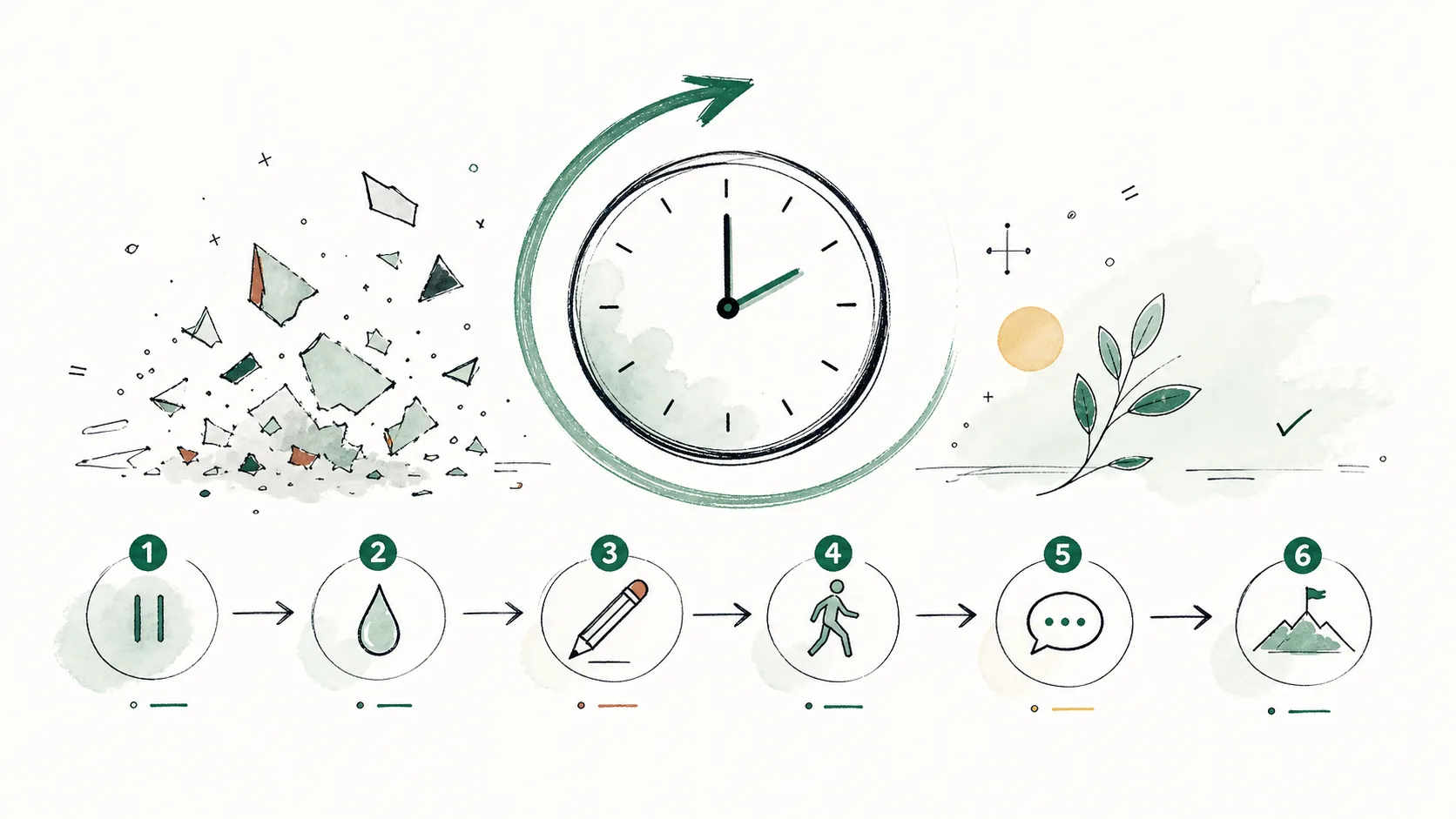
Read this once, then run it. None of these steps require willpower. They require movement.
1. Change your physical state for ten minutes (now). Cold water on your face or wrists, or a five-minute walk outside, or eat something with protein. The mechanism is real: cold exposure on the face activates the diving reflex and shifts vagal tone, walking changes interoceptive signals, food breaks the post-orgasm hormonal slump. You are not trying to feel good. You are trying to interrupt the trough. Ten minutes is enough.
2. Put your phone in another room for the next thirty minutes. Not face down on the couch. In another room. The cue reactivity literature is unambiguous: proximity to the device that delivered the last hit is the single strongest predictor of the next one in the same window (Brand et al., 2019). This is not about discipline. It is about geography.
3. Write down what happened, in one sentence. Open a notes app or a piece of paper. One sentence: where you were, what state you were in, what the thought sounded like just before you opened the tab. Not a paragraph of self-analysis. One line of data. This is ACT-style defusion plus the kind of pattern capture that makes the next slip less likely. The act of writing it down moves the event from "who I am" to "a thing that happened, with causes."
4. Do not make any declarations. Not "I'm done forever." Not "I'll start fresh tomorrow." Not "that's my last time." Declarations in this state are AVE bait. They feel like resolution; they function as permission slips for the next slip, because they implicitly accept that today is already lost. Today is not lost. Today is the hour you are in.
5. Re-engage your body in something non-screen for at least twenty minutes. Shower, cook a real meal, stretch, go to a shop, sit outside, call someone about something unrelated. The point is to give your nervous system a different signal to process. Witkiewitz and colleagues' mindfulness-based relapse prevention work shows that returning attention to body sensations in the post-lapse window reduces the probability of a second use within the following 24 hours (Witkiewitz, Marlatt, & Walker, 2005).
6. If you have someone or something to text, text them now. A friend who knows. A therapist. Iris. This is not about confession. It is about pulling the event out of your own head, where it will spiral, and into a thread, where it becomes a thing with edges. This is the entire reason Iris lives in Telegram: the post-lapse hour is when help has to be five seconds away, not five clicks away.
These six steps take less than an hour together. Done in this window, they do real work. Done tomorrow, they do almost none.
What this slip actually means
It means you have a pattern, and the pattern produced an output. That is data. It is not a verdict on you and it is not the end of anything.
If you have been at this for a while, the slip probably fits a shape you already half-recognise. A particular time of day. A particular state, often tired or under-fed or bored or lonely or, less obviously, slightly elated. A particular cue, usually involving the device that is still in your hand. The slip is the visible part of a chain that had four or five earlier links, most of which you can learn to see.
Compulsive sexual behaviour disorder, or CSBD, was added to the ICD-11 in 2019 as an impulse-control disorder. It is a real clinical construct, with diagnostic criteria, and it describes what many people with persistent problematic porn use are actually dealing with. Naming it can be useful. It is not the same as moral failure, and it is not the same as "addict for life." Kraus, Krueger, Briken, Kor and colleagues have done careful work mapping the construct and its overlap with related conditions; the short version is that CSBD is treatable, and the treatments that work best are some combination of cognitive-behavioural relapse prevention, ACT, and (for some people) medication targeting comorbid mood or anxiety (Kraus et al., 2018; Kor, Fogel, Reid, & Potenza, 2013).
You do not have to decide today whether you have CSBD. You have to decide what you do in the next forty-five minutes. The diagnosis question can wait. The plan above does not.
What comes tomorrow
Tomorrow, do not declare a fresh start. There is no fresh start. There is the practice you were doing yesterday, with one new data point in it.
When you wake up, spend two minutes looking at the sentence you wrote in step three. Add one more sentence if anything became clearer overnight. Notice without commentary. Then go and live your day. The slip does not earn extra airtime. It has had its hour.
If you want a version of this practice that runs with you instead of just on a page, that is what Iris is. It is the same approach, in your inbox, in the moments you actually need it.
References
Brand, M., Wegmann, E., Stark, R., Müller, A., Wölfling, K., Robbins, T. W., & Potenza, M. N. (2019). The Interaction of Person-Affect-Cognition-Execution (I-PACE) model for addictive behaviors: Update, generalization to addictive behaviors beyond Internet-use disorders, and specification of the process character of addictive behaviors. Neuroscience & Biobehavioral Reviews, 104, 1–10.
Breines, J. G., & Chen, S. (2012). Self-compassion increases self-improvement motivation. Personality and Social Psychology Bulletin, 38(9), 1133–1143.
Hufford, M. R., Witkiewitz, K., Shields, A. L., Kodya, S., & Caruso, J. C. (2003). Relapse as a nonlinear dynamic system: Application to patients with alcohol use disorders. Journal of Abnormal Psychology, 112(2), 219–227.
Kor, A., Fogel, Y. A., Reid, R. C., & Potenza, M. N. (2013). Should hypersexual disorder be classified as an addiction? Sexual Addiction & Compulsivity, 20(1–2), 27–47.
Kraus, S. W., Krueger, R. B., Briken, P., First, M. B., Stein, D. J., Kaplan, M. S., Voon, V., Abdo, C. H. N., Grant, J. E., Atalla, E., & Reed, G. M. (2018). Compulsive sexual behaviour disorder in the ICD-11. World Psychiatry, 17(1), 109–110.
Marlatt, G. A., & Gordon, J. R. (Eds.). (1985). Relapse prevention: Maintenance strategies in the treatment of addictive behaviors. Guilford Press.
Neff, K. D. (2003). The development and validation of a scale to measure self-compassion. Self and Identity, 2(3), 223–250.
Polivy, J., & Herman, C. P. (1985). Dieting and binging: A causal analysis. American Psychologist, 40(2), 193–201.
Tangney, J. P., Stuewig, J., & Mashek, D. J. (2007). Moral emotions and moral behavior. Annual Review of Psychology, 58, 345–372.
Witkiewitz, K., & Marlatt, G. A. (2004). Relapse prevention for alcohol and drug problems: That was Zen, this is Tao. American Psychologist, 59(4), 224–235.
Witkiewitz, K., Marlatt, G. A., & Walker, D. (2005). Mindfulness-based relapse prevention for alcohol and substance use disorders. Journal of Cognitive Psychotherapy, 19(3), 211–228.
If reading this helped, Iris is the same approach as a daily practice, in Telegram, in the moments that matter. Free for 14 days, no card. The first step is the pattern quiz.
Quit porn with Iris.
Iris is a science-backed coach for compulsive porn use, delivered on Telegram. Take the three-minute quiz to see if it's a fit.
Take the quiz →