Am I addicted to porn?
A calm self-check for problematic porn use: the signs that matter, what does not automatically mean addiction, and what to do next if the pattern is costing you.
You are probably not reading this because you watched porn once and felt fine about it.
You are reading because something about the pattern has started to feel less optional. Maybe you keep promising yourself you will stop and then finding yourself back there at midnight. Maybe it is affecting your relationship, your sleep, your work, or your sex life. Maybe the use itself does not even feel that good anymore, but you keep returning to it anyway.
"Porn addiction" is the phrase most people search for. It is not always the cleanest clinical phrase. The better question is not "am I bad?" or even "how many times a week is too much?" The better question is: am I losing control of this behaviour, and is it costing me something real?
That is what this guide is for. No scare claims, no moral lecture, no fake diagnosis from a blog post. Just a clear way to tell the difference between high-frequency use, shame about porn, and a pattern that may genuinely need support.
The short answer
Maybe. But frequency alone is not the test.
Some people watch porn often and do not have anything that looks clinically problematic. Some people watch much less often and have a serious loss-of-control pattern. The amount matters, but only in context. A better test is whether porn has become a behaviour you repeatedly cannot control, even when it is creating consequences you care about.
The clinically safer terms are problematic pornography use and, in broader cases, compulsive sexual behaviour disorder. CSBD is recognised in the ICD-11 as an impulse-control disorder. It is not formally listed in the DSM-5-TR as its own diagnosis, and the field still debates whether the addiction label is the right one. That debate matters, but it should not distract from the practical question in front of you.
If you keep trying to stop, keep failing in predictable situations, and the pattern is damaging your life, the exact label is less important than getting a clearer map and better support.
The signs that matter most
Use this section as a self-check, not as a diagnosis. If several of these fit, it is worth taking the pattern seriously.
1. You have repeatedly tried to stop or cut down, and the attempts do not hold. Not "I should probably watch less." Actual attempts. Deleting accounts, installing blockers, making promises, starting a streak, telling yourself this is the last time, then returning to the same loop.
2. You watch for longer than you intended. You planned ten minutes and lost an hour. You opened one tab and ended up in a search spiral. You told yourself you would stop after orgasm and kept going anyway. The signal is not just time spent. It is the repeated gap between intention and behaviour.
3. You continue despite consequences. Sleep gets worse. Work slips. You avoid your partner. You miss commitments. You feel sexually disconnected. You spend money you did not mean to spend. You keep doing the behaviour after it has started costing you things you actually value.
4. Porn has become a state-change tool. You use it less because you are simply enjoying erotic content and more because you are bored, lonely, anxious, rejected, tired, angry, ashamed, or trying to sleep. This is one of the most important signs. Porn is not only a sexual behaviour here. It has become a fast way to alter how you feel.
5. The behaviour has become secretive or compartmentalised. Privacy is not the same as secrecy. Adults are allowed private sexual lives. The concern is when secrecy becomes a structure: hiding time, clearing evidence, lying by omission, protecting the behaviour from anyone who might interrupt it, or feeling like there is a whole part of your life that cannot be looked at directly.
6. You keep returning even when the use itself is not satisfying. This is common and often confusing. People assume compulsion must feel intensely pleasurable. Often it feels flat, automatic, or vaguely grim. The relief comes from escaping the urge or the emotional state, not from the content being especially rewarding.
7. The loop after use makes the next use more likely. You watch, then feel shame, emptiness, irritation, or hopelessness. That state makes you withdraw. Withdrawal creates more loneliness or stress. Later, porn becomes the way to change that state again. The behaviour feeds the conditions that bring it back.
8. You are escalating in ways that bother you. This might mean more time, more novelty, more intense content, more spending, riskier contexts, or content that clashes with your values. Escalation is not universal, and it should not be exaggerated, but if you recognise it in yourself, it matters.
What does not automatically mean addiction
This is where a lot of online content goes wrong. It treats ordinary sexual behaviour, moral discomfort, and clinical impairment as if they are the same thing. They are not.
Watching porn frequently does not automatically mean addiction. Masturbating does not automatically mean addiction. Having sexual fantasies does not automatically mean addiction. Feeling guilty because of religious teaching, cultural expectations, or a partner's disapproval does not automatically mean addiction.
The ICD-11 language matters here because it tries to avoid pathologising distress that comes only from moral judgement or social disapproval. That does not mean values are irrelevant. If porn use conflicts with your values, that conflict is real and worth taking seriously. But a values conflict is not the same as a loss-of-control disorder.
There are at least three different groups that often collapse into one search phrase:
- Compulsive or impaired users. These people have repeated failed control, continued use despite consequences, and meaningful impairment. They need relapse prevention, environmental friction, therapeutic skills, and sometimes clinical care.
- Morally distressed users. These people may use porn moderately but feel intense shame because the behaviour conflicts with their values. They may need values clarification, shame reduction, and a plan that respects their beliefs without turning every urge into a catastrophe.
- High-frequency recreational users. These people may use porn often without impairment, secrecy, failed control, or distress beyond occasional ambivalence. They may not need treatment at all.
The work is to know which group you are actually in.
A short self-check
Answer these with the last six months in mind.
- Have you made serious attempts to stop or cut down and been unable to sustain them?
- Do you often use porn for longer than you planned?
- Has porn use affected your sleep, work, studies, relationship, sex life, finances, or mood?
- Do you use porn mainly to change a state like stress, loneliness, boredom, rejection, anxiety, or shame?
- Do you hide the amount, timing, content, or consequences from people who matter to you?
- Do you return to porn even when you know it will make you feel worse afterward?
- Do you feel a strong pull to use in specific contexts, such as late at night, alone in bed, after conflict, after drinking, or when procrastinating?
- Have blockers, promises, streaks, or accountability systems failed because you found workarounds?
- Have you escalated in time, novelty, spending, secrecy, or intensity in a way that concerns you?
- If nothing changed for the next year, would the cost be significant?
If you answered yes to one or two, it may be worth paying attention. If you answered yes to several, the useful next step is not a scarier label. It is a clearer map.
Why "how much is too much?" is the wrong question
It is understandable to want a number. Once a week. Three times a week. Daily. Two hours. Five hours. A number would make the question easier.
But porn use does not become problematic at a universal threshold. The same frequency can mean different things in different lives. Daily use for one person might be private but not impairing. Weekly use for another might be the visible tip of a loop that includes secrecy, failed attempts to stop, relationship damage, and shame-driven binges.
The better questions are more concrete:
- What happens before the use?
- What does it do for you in the moment?
- What does it cost afterward?
- What have you tried to change?
- What makes the pattern predictable?
If you can answer those, you know far more than a frequency count would tell you.
The loop behind most problematic porn use
Most problematic porn use is not random. It has a shape.
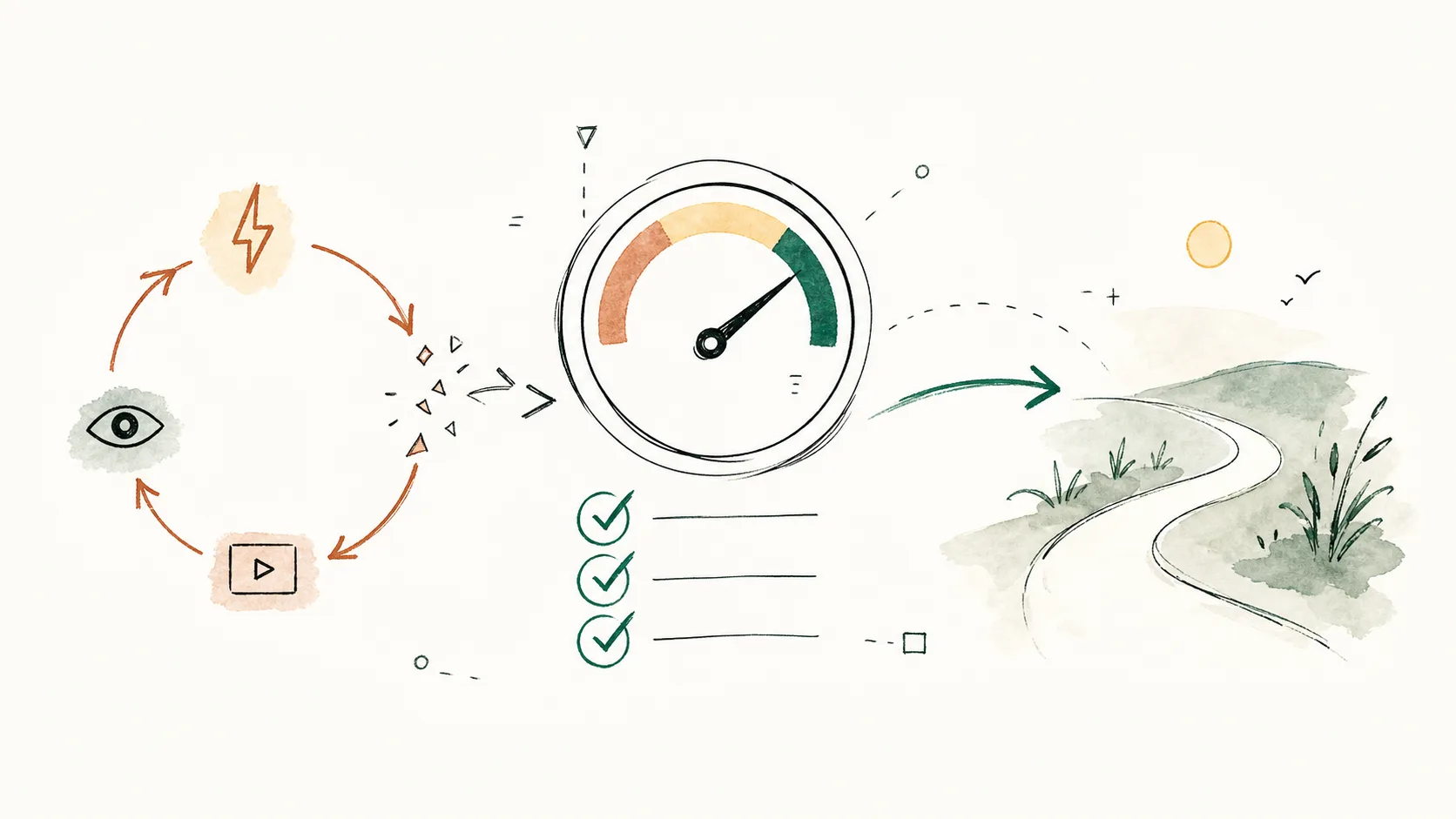
Trigger. Craving. Permission thought. Ritual. Use. Relief. Shame or crash. More vulnerability. Another trigger.
The trigger may be obvious: you are alone in bed with your phone at 11:45pm. Or it may be less obvious: a difficult conversation, a boring afternoon, a rejection, a burst of anxiety, an unresolved task, alcohol, poor sleep, or the hollow feeling after a previous slip.
Then comes the permission thought. It rarely sounds dramatic. It sounds reasonable:
"Just once."
"I already messed up today."
"I need this to sleep."
"I'll start properly tomorrow."
"This does not count."
"I deserve something after today."
The ritual follows: phone out, app opened, private browsing, search term, saved account, familiar pathway. By the time the content appears, the relapse may already be mostly decided. That is why willpower at the final second is such a bad plan. The better intervention is earlier in the chain.
This is also why a lapse can become a longer relapse. If the first use turns into "I have failed again, so today is gone," the next use becomes easier. That is the Abstinence Violation Effect, and it is one reason streak-based approaches can backfire for some people. We wrote a full guide to that moment in the hour after a slip.
What to do if the pattern fits
Start with a map, not a vow.
For the next week, do not try to produce a perfect recovery narrative. Track the pattern. Each time an urge or slip happens, write down five things:
- Time of day.
- Device and location.
- Emotional state.
- Permission thought.
- First small step in the chain.
This gives you the actual problem. Without it, you are fighting "porn addiction" in the abstract. With it, you may discover the specific pattern is "phone in bed after midnight when I feel lonely and under-slept." That is a solvable problem.
Then add friction. Friction is not a cure, but it buys time. Phone out of the bedroom. Laptop only in a public room. Blockers on high-risk devices. Private browsing restricted where possible. Payment details removed from sites and app stores. Evening shutdown. Less alcohol when alone. A pre-planned routine for the hour you usually slip.
Then build an urge protocol. It should be short enough to use when you are activated:
- Stand up.
- Put the phone down.
- Leave the room.
- Name the trigger.
- Delay ten minutes.
- Do one replacement action: shower, walk, push-ups, tea, text someone, tidy the room, go outside.
- Log what happened.
The goal is not to win an argument with the urge. The goal is to change state and delay action long enough for the wave to move.
When to get more help
Consider speaking to a therapist, GP, doctor, or qualified mental health professional if the pattern is causing serious impairment, if you have repeatedly failed to stop despite major consequences, or if porn use sits alongside depression, anxiety, ADHD, OCD, trauma, alcohol or drug use, or relationship crisis.
Get urgent support if you are having thoughts of self-harm, if you feel at risk of harming someone else, or if your use involves illegal material. A blog post or app is not the right container for those situations.
For many people, the strongest recovery stack is not complicated: a clear assessment, a relapse map, environmental friction, CBT-style relapse prevention, ACT-style urge tolerance, shame reduction, and a life that starts replacing the function porn was serving.
The next useful step
If several signs above fit, the next useful step is not to decide whether you are permanently "an addict." That label is too heavy and too blunt for the first move.
The next useful step is to understand your pattern.
The Iris quiz takes about five minutes and gives you a written picture of the conditions that tend to drive your urges: stress, boredom, loneliness, late-night access, shame, relationship conflict, or habit loops. From there, the work becomes less mysterious. You are no longer fighting a vague enemy. You are changing a specific chain.
That is where recovery usually starts to become practical.
References
Bőthe, B., Tóth-Király, I., Potenza, M. N., Orosz, G., and Demetrovics, Z. (2020). High-frequency pornography use may not always be problematic. The Journal of Sexual Medicine, 17(4), 793-811.
Bőthe, B., Koós, M., Nagy, L., Kraus, S. W., Demetrovics, Z., and colleagues. (2024). Problematic pornography use across countries, genders, and sexual orientations: Insights from the International Sex Survey and comparison of different assessment tools. Addiction, 119(5), 928-950.
Kraus, S. W., Krueger, R. B., Briken, P., First, M. B., Stein, D. J., Kaplan, M. S., Voon, V., Abdo, C. H. N., Grant, J. E., Atalla, E., and Reed, G. M. (2018). Compulsive sexual behaviour disorder in the ICD-11. World Psychiatry, 17(1), 109-110.
Kraus, S. W., Martino, S., and Potenza, M. N. (2016). Clinical characteristics of men interested in seeking treatment for use of pornography. Journal of Behavioral Addictions, 5(2), 169-178.
Mayo Clinic Staff. (2023). Compulsive sexual behavior: Diagnosis and treatment. Mayo Clinic.
Marlatt, G. A., and Gordon, J. R. (Eds.). (1985). Relapse prevention: Maintenance strategies in the treatment of addictive behaviors. Guilford Press.
World Health Organization. (2024). ICD-11 for Mortality and Morbidity Statistics: Compulsive sexual behaviour disorder.
If this felt uncomfortably familiar, start with the pattern quiz. It is five minutes, private, and designed to map the loop rather than shame you for having one.
Quit porn with Iris.
Iris is a science-backed coach for compulsive porn use, delivered on Telegram. Take the three-minute quiz to see if it's a fit.
Take the quiz →