I tried to quit for 12 years. NoFap made it worse.
A founder's account of twelve years inside the NoFap framework, why the streak structure made things harder, and what eventually changed. Plus the cleanest description I know of the Abstinence Violation Effect.
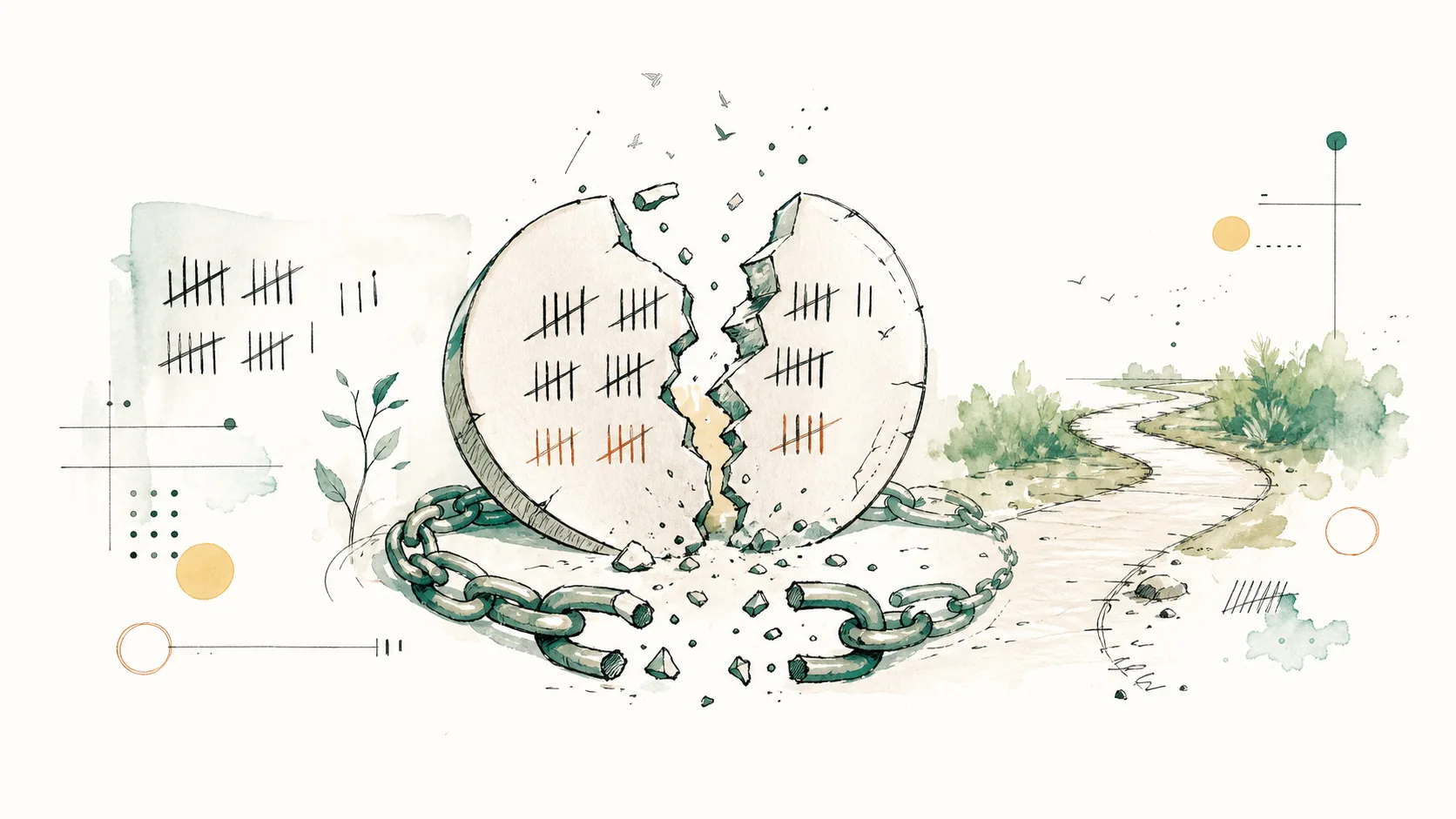
I run Iris now, which is an evidence-based recovery tool for compulsive porn use. Twelve years ago I was on day 47 of my fourth NoFap reset, and I was certain I had finally cracked it. I had not. I would reset again that week, and many times after that. What follows is what I learned, slowly and against my own preferences, about why the framework I trusted for most of my twenties kept producing the opposite of the result I wanted.
How I found NoFap
I came across NoFap in roughly [YEAR I FIRST FOUND NOFAP], around [ROUGH AGE AT FIRST ATTEMPT]. The route in was [ROUGHLY HOW I FOUND IT, Reddit thread, friend, etc.]. For most men of a certain age this is a recognisable origin story. NoFap in its early-2010s heyday was the first framework many of us encountered that named the problem out loud. Before that, the available vocabulary was either clinical and inaccessible, religious and freighted, or non-existent. NoFap offered something different. It said, here is a thing a lot of you are doing; here is what it looks like; here is what you can try.
That was, on its own, a meaningful piece of public infrastructure.
Why it was appealing
I want to be careful here, because the easy move when you are about to criticise something is to skip the part where you acknowledge what it did well. NoFap did several things well, and it is worth saying so before saying anything else.
It named the problem. Until around 2011 there was effectively no popular language for compulsive porn use that did not collapse into either moralism or pathology. NoFap produced a vocabulary, flatmate, chaser effect, reset, and that vocabulary did real work. It let people locate their experience.
It built community at a moment when nobody else was hosting one. The subreddit was, for years, the only place I knew of where the conversation happened in something close to ordinary language. People described things I had assumed were peculiar to me. The relief of that recognition is hard to overstate, and the community itself genuinely helped people in the short run.
It gave the experience a frame that did motivational work. For a subset of users, the streak counter is genuinely useful. It externalises progress, it produces a small daily ritual of noticing, and for some people, those features are exactly what is needed. I do not want to claim otherwise. There are people for whom NoFap worked, and continues to work, and that is real.
And it took the problem seriously at a time when most men's mental health discussion did not. That alone earned it the audience it had.
I want all of that on record before the next section, because the structural critique that follows is not a hatchet job. It is the thing I wish someone had said to me in 2012.
What happened across twelve years
The pattern, not the timeline. I attempted to stop, restarted, attempted again, restarted, and so on, across what was eventually most of my twenties and into my thirties. Some streaks were long. Some were short. The lengths varied, but the structure was the same. Each new attempt began with a more elaborate preamble than the last. I added blockers, then learned how to bypass the blockers. I signed up accountability partners, who eventually ghosted, as did I. I wrote increasingly detailed plans about how this time would be different.
The thing nobody told me, and the thing I would not have believed if they had, is that the longer this went on, the more fragile each streak became. Not less. More. Because the identity riding on the next streak was bigger every time. By year six or seven, a slip was not just a slip. It was evidence about who I was. The accumulated weight of failed attempts is its own variable, and it does not get talked about because it is not measurable on a counter.
The bit that surprises me looking back is how much of the engine was the counter itself, and how little of it was the underlying behaviour. If I had been asked, at year five, whether the porn use or the failed-attempts pattern was the bigger problem, I would have said the porn use without hesitation. By year ten I would have given the opposite answer, and I would have been right. The behaviour was on a slow downward drift across the decade. The pattern of restart, identity inflation, and collapse was on a steady upward one. They were related, but they were not the same problem, and conflating them cost me years.
The mechanism I didn't know about
Marlatt and Gordon (1985) described something called the Abstinence Violation Effect. The concept is simple. When a person who has committed to abstinence from a behaviour breaks that commitment, the way they interpret the lapse strongly predicts what happens next. If the lapse is interpreted as a personal failure, evidence of a stable defect, the probability of a second use within a short window goes up sharply. Polivy and Herman (1985) found a parallel pattern in eating behaviour and called it the what-the-hell effect. The mechanism in both cases is the same. The lapse triggers a cognitive collapse of the original commitment, and the second use becomes easier than the first because there is no longer anything to protect.
I did not know about any of this for most of the twelve years. What I experienced, repeatedly, was that a broken streak rarely stopped at the broken streak. It became a three-day window of further use, sometimes longer, and the next attempt began with a more elaborate set of conditions than the last. I thought this was a character problem. It is not. It is a well-documented behavioural pattern, and it is what the AVE looks like in the wild.
The structural point about NoFap is uncomfortable. The streak counter, by design, makes the moment of rule violation maximally visible. Visibility plus shame predicts second use. That is what the literature says, fairly consistently, across the substance-use and disordered-eating fields. The streak design takes the variable the AVE feeds on, the symbolic weight of the lapse, and makes it the centrepiece of the experience.
I have written a longer walkthrough of how this plays out moment-to-moment in the hour after a slip, for anyone who wants the mechanism in more detail.
The shame engine
Tangney, Stuewig and Mashek (2007) drew a distinction that I now think is one of the most useful in this entire field. Guilt is about an action. Shame is about a self. The evidence across nearly every behavioural domain is consistent. Guilt tends to be adaptive; it prompts repair. Shame tends to be maladaptive; it prompts avoidance, concealment, and, importantly, further transgression. Shame-prone responding is associated with higher rates of relapse across substance use, disordered eating, and compulsive sexual behaviour.
NoFap's framing is shame-loaded in exactly the way the literature warns about. The reset language, the counter resetting to zero, the implied identity of the person who has reset, all of these pull toward shame rather than guilt. I want to be fair about this. The framers of NoFap were not clinicians, the relevant literature was not widely read in 2011, and the design choices that produced this effect were not malicious. They were the obvious choices given the goal. They simply happened to be the choices that the shame literature predicts will produce worse long-run outcomes.
The personal version is this. The part of me that eventually broke was not the part that used porn. It was the meta-belief that I was the kind of person who keeps failing at this. That belief, by year ten, was doing more damage than the behaviour it was supposedly there to correct.
What actually shifted
I am wary of the genre of essay in which the writer announces, around the three-quarter mark, that they figured it out. I did not figure it out. The slope of the pattern started bending in the right direction over a period of [BRACKETED TIMEFRAME], and three things contributed.
The first was reading the actual relapse-prevention literature. Marlatt and Witkiewitz's later work on mindfulness-based relapse prevention (Witkiewitz and Marlatt, 2004), Brand and colleagues' I-PACE model (Brand et al., 2019), Kraus and colleagues' review of compulsive sexual behaviour as it appeared in ICD-11 (Kraus et al., 2018). The clinical picture is not the NoFap picture. It is more boring, more mechanistic, less heroic, and considerably more useful. Lapses are events to study. Triggers are antecedents to map. Cravings are time-limited physiological states with reasonably well-understood trajectories. None of this is comforting in the way the NoFap frame is comforting, and that is a feature, not a bug.
The second was dropping the counter. The day I stopped tracking days was the day the AVE stopped having something to break. I do not say this lightly. The counter had been the spine of my attempts for years. Removing it felt, initially, like removing the load-bearing wall of the project. What happened instead was that the unit of analysis shifted from "how long since" to "what happened in the last 24 hours and what state was I in." That second question turns out to be the more productive one.
The third was treating it as a regulatory problem rather than a willpower problem. Almost every lapse I logged, once I started logging properly, was preceded by a state I was trying to change. Tiredness, low mood, social residue from a difficult interaction, the boredom of a Sunday afternoon, the specific overstimulation of having been online for too long. The behaviour was a regulation strategy, badly chosen but functionally coherent. Once I could see that, the question was no longer "how do I stop wanting this." It was "what is the state, and is there a less costly way to move it." Self-compassion work (Neff, 2003; Breines and Chen, 2012) was part of this, and the evidence on self-compassion as a regulation tool is better than I expected when I started reading it.
I want to be honest. Things still went wrong after these shifts. Lapses still happened. The difference was that the lapses stopped cascading. The second use did not follow the first as reliably. The AVE signature got quieter. That is the shape of the change, and it took a while.
The other thing worth saying, because it does not get said often enough, is that none of the three shifts felt impressive from the inside. There was no moment of clarity. Reading the literature was tedious in places. Dropping the counter felt, for the first few weeks, like giving up. Reframing lapses as regulatory events sounded, at the time, like an excuse I was making for myself. The honest description is that the shifts felt mildly disappointing while they were happening, and the result was that the underlying pattern started to behave better. That is, I think, the more common shape of change in this domain, and the heroic version sells better but happens less often.
Why I built Iris
The thing that did not exist when I needed it was an evidence-grounded coach in the inbox you actually check at 11pm, with no counter to reset, with lapses treated as data, with the AVE named for you so you can see it happening in real time rather than from the wrong side of a 72-hour binge. I looked around, several times across several years, and the thing I wanted was either an app that re-implemented the NoFap counter with a nicer UI, or a £200-a-session therapist with a six-week waiting list. The middle was empty.
So I built it. Iris is a Telegram-native AI coach, anti-streak by design, intended to pair with blockers rather than replace them, and grounded in the relapse-prevention and I-PACE literature rather than in folk frameworks. If you want the comparison with the existing apps, I wrote about that in the tools review.
That is the product description. I will not pitch it further here.
To anyone still on a NoFap streak
I am not going to tell you to leave NoFap. If it is working for you, it is working. The streak structure is genuinely the right shape for a subset of people, and the community has done real good for real people. The question worth asking is about the failure mode. What happens to you when the streak breaks? Is the next slip a small slip or a long one? Is the recovery from a lapse getting easier over time, or harder? Is the identity riding on the counter getting heavier each cycle, or lighter?
If the next slip is consistently worse than the one before it, not better, that is the AVE signature, and the framework is not on your side. That is not a moral judgement about the framework or about you. It is a structural observation about how the design interacts with how lapses propagate.
If it is working, keep going. If the pattern above is the one you recognise, the literature has a different picture, and it is worth reading.
Iris is the thing I wish had existed twelve years ago. Five-minute pattern quiz if you want to map where you actually are.
References
Brand, M., Wegmann, E., Stark, R., Müller, A., Wölfling, K., Robbins, T. W., and Potenza, M. N. (2019). The Interaction of Person-Affect-Cognition-Execution (I-PACE) model for addictive behaviors: Update, generalization to addictive behaviors beyond internet-use disorders, and specification of the process character of addictive behaviors. Neuroscience and Biobehavioral Reviews, 104, 1–10.
Breines, J. G., and Chen, S. (2012). Self-compassion increases self-improvement motivation. Personality and Social Psychology Bulletin, 38(9), 1133–1143.
Kraus, S. W., Krueger, R. B., Briken, P., First, M. B., Stein, D. J., Kaplan, M. S., Voon, V., Abdo, C. H. N., Grant, J. E., Atalla, E., and Reed, G. M. (2018). Compulsive sexual behaviour disorder in the ICD-11. World Psychiatry, 17(1), 109–110.
Marlatt, G. A., and Gordon, J. R. (1985). Relapse prevention: Maintenance strategies in the treatment of addictive behaviors. New York: Guilford Press.
Neff, K. D. (2003). The development and validation of a scale to measure self-compassion. Self and Identity, 2(3), 223–250.
Polivy, J., and Herman, C. P. (1985). Dieting and binging: A causal analysis. American Psychologist, 40(2), 193–201.
Tangney, J. P., Stuewig, J., and Mashek, D. J. (2007). Moral emotions and moral behavior. Annual Review of Psychology, 58, 345–372.
Witkiewitz, K., and Marlatt, G. A. (2004). Relapse prevention for alcohol and drug problems: That was Zen, this is Tao. American Psychologist, 59(4), 224–235.
Quit porn with Iris.
Iris is a science-backed coach for compulsive porn use, delivered on Telegram. Take the three-minute quiz to see if it's a fit.
Take the quiz →